Greed and Inheritance
Young Captain Jack · The Son of a SoldierGreed and Inheritance names the struggle in which wealth and property become instruments for controlling family identity. The novel links inheritance to marriage, adoption, shipwreck evidence, and disputed paternity: whoever can define Jack Ruthven’s parentage can also define who may possess the fortune. Against that possessive logic, the ending restores property through proof and law, while separating genuine family loyalty from the desire to acquire land and money.
Property, Marriage, and Plantation Ambition
St. John Ruthven first approaches property as a problem to be solved through marriage. He tells his mother that he has an idea which may secure their future and proposes marrying Marion Ruthven so that the two plantations can be joined, giving both of them a comfortable living. His proposal treats marriage less as an emotional union than as an economic arrangement, and its practical purpose exposes the pressure exerted by declining prospects and inherited land.
The plan encounters a decisive obstacle when St. John learns that Marion Ruthven intends to leave half the property to Jack Ruthven. Old Ben reports this information to him, and St. John reacts with amazement. The inheritance therefore threatens to redirect the material future he hoped to secure through marriage. Jack’s position within the Ruthven household is no longer merely a question of affection or belonging; it becomes a question of who will control land and resources.
Jack Ruthven’s Identity as an Inheritance Dispute
Jack’s uncertainty begins with the humiliating claim that he is a nobody who does not belong to the Ruthven family and may one day have to leave. Marion Ruthven corrects that social insult by explaining that Alice Ruthven and her husband adopted him when he was about three or four years old and that he is now John Ruthven, her brother. Yet adoption gives Jack a family without immediately giving him a known biological lineage, leaving his legal and financial position vulnerable to later claims.
The physical traces of Jack’s origin are correspondingly fragile. Alice Ruthven preserves the clothing and an unmarked lace handkerchief belonging to the woman who died after the shipwreck, along with a ring worn on one of her fingers. The ring once carried a marking, but it had been worn away so thoroughly that even two jewelers could not decipher it. When Alice brings the small jewel casket and passes the ring to Jack, the object promises a connection to the past while withholding the identification needed to establish an inheritance.
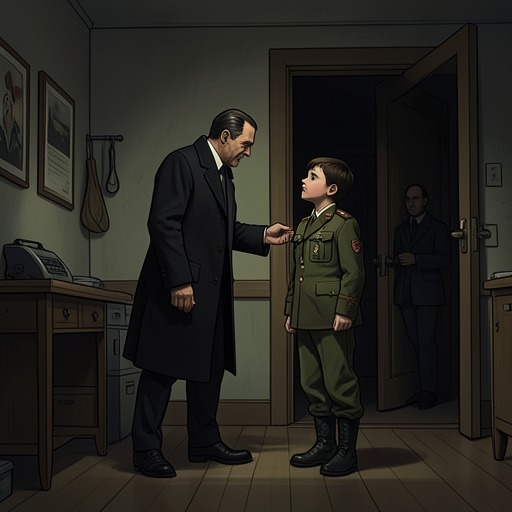
This uncertainty permits competing versions of Jack’s parentage to circulate. Dr. Mackey claims, “Jack, I am your father!” and presents himself as the man who can supply Jack with a name, a biological connection, and a fortune. Later, the truth is reversed: Jack is told that he is not Dr. Mackey’s son but Colonel Stanton’s son, a fact Colonel Stanton has proved beyond doubt. The succession of claims shows how closely the language of kinship is tied to economic advantage. “Father” is not only a familial title; in this plot it is also a claim to property.
Dr. Mackey’s Acquisition of the Evidence
Dr. Mackey’s greed becomes concrete in his search for documentary proof. In a concealed closet aboard the wreck, he digs through a solid cake of dirt and uncovers a heavy black-painted tin box. The box is locked, but he opens it with a key from his own bunch of keys and finds a marriage certificate, letters from the man’s father concerning the property, and letters from the woman’s family. He immediately recognizes the documents as the means by which the fortune can be controlled and declares that the fortune is his.
The black tin box converts the inheritance conflict from rumor into an evidentiary struggle. Its contents connect marriage, family correspondence, and property, while Dr. Mackey’s act of hiding the box under his coat demonstrates that he treats evidence as something to possess rather than disclose. The wreck preserves the past materially, but access to that past is governed by whoever can retrieve, conceal, or interpret its documents.
Dr. Mackey later offers Jack “a name, a good home, and your share of a large fortune,” but the offer is conditional. Jack will receive his full share only if he does what Dr. Mackey wishes. The language of generosity therefore masks coercion: the supposed father offers wealth as leverage, attempting to make Jack accept a claimed identity in exchange for obedience. Dr. Mackey’s statement that he is wealthy, or will be once he proves his identity, further reveals that his own name is unstable and that his economic ambitions depend upon establishing a usable legal story.
Exposure, Prosecution, and Restitution
The conflict ends when Colonel Stanton’s identity and relationship to Jack are established, displacing Dr. Mackey’s false claim. After the American Civil War, Colonel Stanton resigns from the army and prosecutes Dr. Mackey in order to recover the fortune due to himself and Jack. The legal action gives the inheritance a public framework that private assertions and concealed documents had denied it.
The result is both punitive and material. Dr. Mackey receives a ten-year prison sentence, while within a year Colonel Stanton and Jack come into possession of a fortune worth one hundred and fifteen thousand dollars. Wealth is recovered, but it is no longer presented as the reward for the most aggressive claimant. It follows the confirmed relationship between father and son and is restored through legal process.
The final arrangement also prevents inheritance from remaining a purely financial settlement. Colonel Stanton initially considers returning North, but Alice Ruthven does not want to be separated from Jack, so everyone remains at the plantation. A year later Colonel Stanton marries the widow, and Alice, now Mrs. Stanton, becomes Jack’s mother once more. Jack’s response that this is exactly what he wanted makes the emotional consequence explicit: the recovered fortune matters, but restored family continuity matters more.
Thematic Significance
The novel contrasts two uses of inheritance. St. John Ruthven sees property as something marriage can consolidate; Dr. Mackey sees parentage as a route to wealth and uses a fortune to pressure Jack; Alice Ruthven treats family as a bond maintained through adoption and care. These positions place economic calculation beside forms of belonging that cannot be reduced to ownership.
The recurring evidence—the ring, the handkerchief, the marriage certificate, the letters, and the black tin box—shows that inheritance depends upon both material objects and the stories attached to them. Objects can preserve a hidden history, but they do not speak automatically. Their meaning is contested by witnesses, claimants, and courts. The final revelation that Jack is Colonel Stanton’s son resolves the contest because it joins biological truth to demonstrable proof, while the marriage of Colonel Stanton and Alice Ruthven reunites legal, emotional, and household relationships.
Greed and Inheritance thus functions as more than a subplot about money. It tests whether family can be manufactured by a profitable claim, whether marriage can be reduced to plantation arithmetic, and whether documents can be turned into instruments of possession. The ending answers by punishing fraudulent appropriation and returning wealth to its rightful holders, while presenting adoption, loyalty, and the renewed household as forms of inheritance that money alone cannot create.